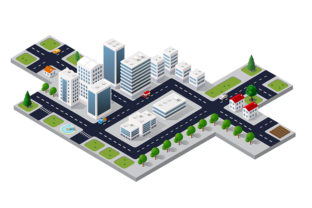
Isometric 3D Cityscape View: A Comprehensive Evaluation
In the realm of digital design and urban visualization, the Isometric 3D Cityscape View has emerged as a distinct and versatile visual language. Unlike traditional perspective drawing, which mimics the human eye's convergence on a vanishing point, isometric projection utilizes parallel lines to represent three-dimensional objects on a two-dimensional plane. This specific approach creates a unique aesthetic that combines technical precision with artistic charm. For professionals in architecture, game development, and graphic design, understanding the nuances of this view is essential for making informed decisions about how to present complex urban environments.
Defining the Isometric Perspective in Urban Design
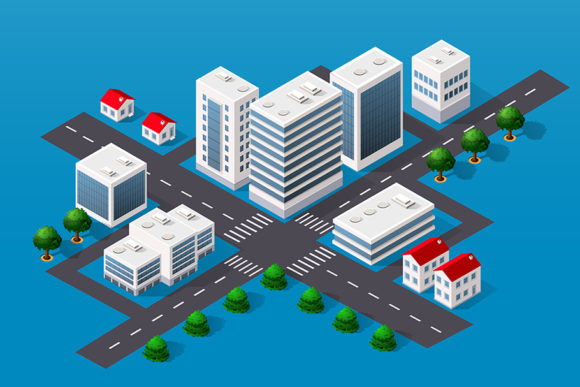
An isometric cityscape is characterized by a fixed viewing angle where the vertical lines remain vertical, and horizontal lines are drawn at 30-degree angles from the horizontal axis. This geometric consistency ensures that no single part of the structure appears larger or smaller based on its distance from the viewer. In practical terms, this allows designers to create detailed illustrations of buildings, roads, trees, and infrastructure without the distortion common in one-point or two-point perspective.
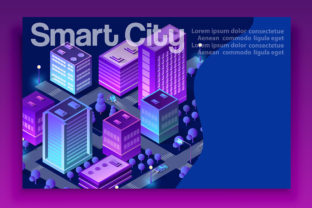
When applied to a downtown or residential district, this view transforms a flat map into a tangible model. It captures the essence of an urban landscape while maintaining a level of abstraction that makes complex data or architectural plans easier to digest. Whether depicting a skyscraper cluster, a quiet suburban street, or an industrial zone, the isometric format provides a clear, unambiguous representation of spatial relationships.
Why Professionals Choose Isometric Views
The decision to utilize an isometric 3D cityscape view often stems from specific functional requirements rather than mere stylistic preference. One of the primary drivers is clarity. Because the scale remains consistent across the entire image, viewers can accurately gauge the size of a house relative to a tower or the width of a road compared to a park. This makes the format particularly valuable for real estate presentations, where potential buyers need to understand the layout of an estate or apartment complex without getting lost in unrealistic perspective distortions.
Furthermore, this style is highly effective for game design and user interface (UI) elements. Strategy games and simulation titles frequently rely on isometric views because they allow players to see the maximum amount of information on the screen simultaneously. There are no hidden corners behind tall structures, and the transport networks, commercial buildings, and landmarks are all visible at a glance. The clean lines and structured nature of the vector graphics also facilitate animation and interactivity, making it a staple for mobile apps and web-based planning tools.
Benefits and Practical Advantages
- Information Density: The view allows for the inclusion of extensive details, such as billboards, cars, and street furniture, without cluttering the composition. Every element contributes to the narrative of the city.
- Scalability: As a vector illustration, these images can be scaled up or down infinitely without losing quality. This is crucial for graphic designers who need to adapt assets for various media, from small icons to large poster prints.
- Aesthetic Consistency: The uniform geometry creates a cohesive look that feels organized and professional. It bridges the gap between technical blueprints and colorful cartoon art, appealing to both engineers and general audiences.
- Modularity: Designers can easily swap out individual elements like office blocks, residential units, or tree types to create different versions of the same map or template.
Tradeoffs and Considerations
While the benefits are significant, relying on an isometric 3D cityscape view involves certain tradeoffs that must be weighed during the planning phase. The most notable limitation is the lack of depth perception found in realistic rendering. Because the perspective is mathematically rigid, it cannot replicate the dramatic shadows, atmospheric haze, or the emotional impact of a photorealistic photograph. If the goal is to convey the mood of a rainy evening in a metropolis or the grandeur of a sunset over a skyline, a standard perspective render may be more appropriate.
Additionally, creating high-quality isometric assets requires specialized skills. Artists must possess a strong grasp of geometry and grid systems to ensure that all structures align perfectly. A slight error in angle can make a building look tilted or distorted. Furthermore, the stylized nature of the art means it may not fit every brand identity. A corporate firm seeking a hyper-realistic, serious tone might find the playful or schematic nature of an isometric illustration too informal.
Situational Fit: When to Use Isometric Views
The isometric 3D cityscape view is a strong fit for projects requiring educational clarity or strategic overview. It is ideal for:
- Urban Planning Proposals: Showing citizens how a new district will look without overwhelming them with technical jargon.
- Infographics and Data Visualization: Mapping out population density, traffic flow, or economic zones using building heights and colors as indicators.
- Game Assets and UI: Creating backgrounds for strategy games or menu screens where readability is paramount.
- Architectural Concept Art: Presenting early-stage designs where the focus is on massing and layout rather than material textures.
When Alternatives May Be Preferable
There are scenarios where an alternative approach yields better results. If the objective is marketing a luxury property, a photorealistic exterior render with dynamic lighting often sells the lifestyle better than a schematic view. Similarly, for virtual reality experiences or immersive simulations, a first-person perspective is necessary to provide a sense of presence that an isometric camera cannot offer. In cases where the project demands extreme realism, such as film production or high-end architectural visualization, ray-traced rendering techniques are superior to vector-based isometric models.
Decision-Making Insights
To determine if an isometric 3D cityscape view aligns with your goals, consider the following questions regarding your project needs:
- What is the primary message? If you need to explain "how" a system works or show relationships between elements, isometry excels. If you need to evoke emotion or sell a feeling, other styles may be better.
- Who is the audience? Technical stakeholders appreciate the accuracy of isometric maps. General consumers may prefer the familiarity of photographs.
- What is the medium? Isometric graphics are lightweight and responsive, making them perfect for web and mobile applications. They are less suitable for large-scale physical billboards unless printed at very high resolutions.
Ultimately, the choice comes down to the balance between clarity and immersion. The isometric style offers a unique vantage point that simplifies complexity, turning a chaotic metropolis into an organized collection of elements. By carefully evaluating the strengths and limitations outlined above, designers and planners can leverage this powerful visual tool to communicate their vision effectively.